
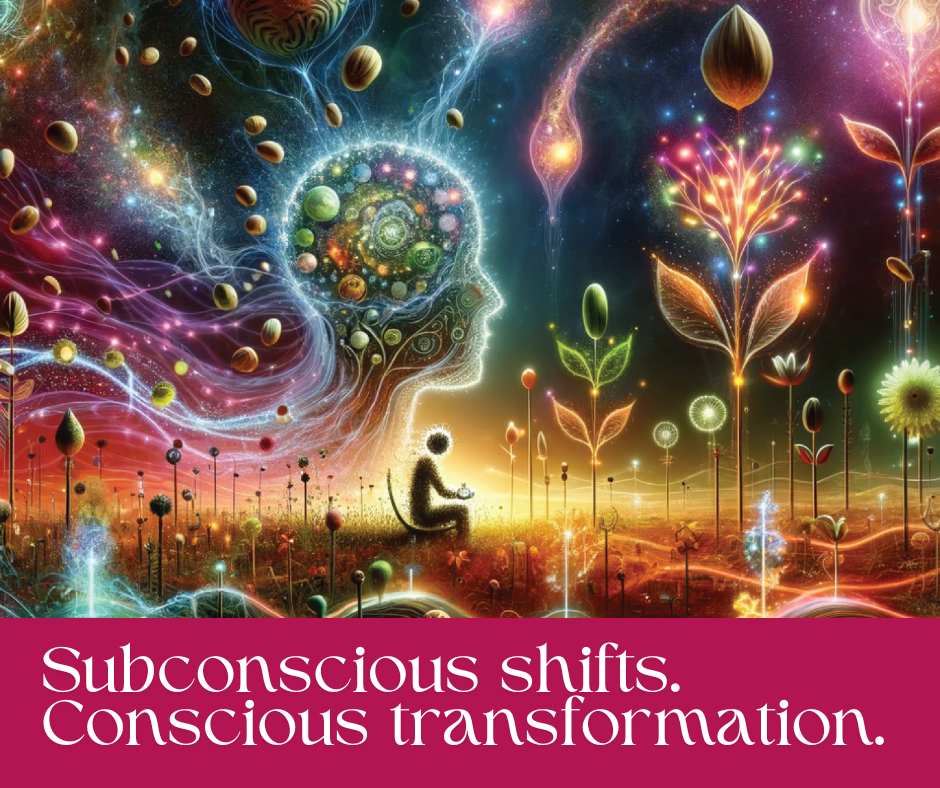
Hypnotherapy is an effective, non-invasive, and a natural guided process of focused attention and deep relaxation that allows you to access the subconscious mind by bypassing the conscious (overthinking, logical) mind. In this state, your mind becomes more receptive to insight, new perspectives, and meaningful change.
You remain aware, present, and in control throughout the process. Many people describe the experience as calming, meditative, and deeply restorative.
In hypnotherapy, you will experience a trance-like state in which your mind and physical body can relax but you can also experience heightened focus and concentration. Trance is actually very natural for us (especially for kids) and we often experience this in momentary situations when we are in between the conscious and unconscious state (not fully awake and not fully asleep)… the breath tends to slow down and muscles relax and let go, you feel a pleasant and almost euphoric state. This occurs naturally in our daily lives when we are sitting in a meeting or classroom and daydream…when we lose track of time when we are having fun…when we are deeply captivated in a movie and don’t hear our name being called…when we are on a road trip and zone out for a bit only to “wake up” and wonder how far we’ve driven. There are numerous examples of how we enter this trance state.
Hypnotherapy can be used to help you gain control over patterns, behaviors, fears, thoughts, feelings, and actions. It can be a guide to past experiences and clarify causes/reasons. It can help you gain a better understanding of yourself and your relationships with others and it can provide a glimpse into future life experiences, goals, and life purpose.
Hypnotherapy allows us to process subconscious elements that we are not tapping into in our daily lives. For instance, if a ten-year-old experiences their parents’ divorce and internalizes the belief that they are always going to be abandoned in relationships, they may grow up and develop issues pertaining to trust and opening up. This pattern can be zeroed in on, re-discovered and processed during a hypnotherapy session.
Why the Subconscious Mind Matters
The subconscious mind shapes how we respond to stress, relationships, self-esteem, habits, and emotional triggers—often without us realizing it.
Hypnotherapy helps you:
- Identify and shift unconscious patterns
- Release outdated beliefs and emotional imprints
- Build new internal responses rooted in safety and confidence
- Integrate insight at a deeper, embodied level
Rather than working against yourself, hypnotherapy teaches you how to work with your mind’s natural intelligence.
How are we different?
At Lotus Wellness Center, we have hypnotherapists who have a background, training, and experience as mental health therapists. They have years of experience that allow them to look at issues from a clinical perspective, but also integrate alternative modalities. Hypnotherapy sessions, as a result, integrate therapeutic processing, interpretation and follow a treatment-oriented approach to elicit long-lasting healing and transformation.
What Hypnotherapy Can Support
- Stress, anxiety, panic, phobias
- Depression, emotional overwhelm, and mood regulation
- Heal trauma wounds and regulate the nervous system
- Grief, loss, and emotional processing
- Reshaping habits from within (smoking, nail biting, overeating, etc.)
- Sleep issues and chronic stress/tension
- Self-confidence, motivation, and clarity
- Life transitions and personal growth
- Reframe intrusive worry thoughts on a subconscious level
- Work through emotional, psychological, or physical pain
- Release phobias
- Overcome procrastination, doubt, fear
- Increase self-esteem and self-worth
- Pain management or understanding the cause (ie. Migraines, IBS, chronic illness)
- Lasting weight management and optimal health ~ feel healthier and more confident in your body
- Break free from the cycle of addiction & take control over cravings
- Release anger and unresolved grief
- Gain insight around interpersonal relationships
- Create peak performance states for athletes
- Prepare for exams and interviews (improve memory, retention, comprehension, confidence)
- Explore personal goals and life purpose, personal and/or spiritual development
Each session is tailored specifically to your personalized goals and readiness.
How can I benefit from hypnotherapy?
As a rule of thumb, every single modality or treatment will not be beneficial for every person. Those who are good candidates for hypnotherapy can look forward to a better understanding of self or their symptoms, long lasting shifts and transformation, healing and growth. I sometimes like to explain this to clients – since our subconscious mind holds so many repressed thoughts, feelings, experiences and ideologies that are not revealed in daily life but are still driving forces for our current thoughts and behaviors, hypnotherapy can orient us to the root of the problem in a faster way than traditional psychoanalysis or psychotherapy. Important information that is relevant can be brought to light in a faster time frame. It is also extremely helpful to have a hypnotherapy session in the midst of traditional therapy sessions since this allows ample opportunities to process, integrate, and invoke change producing shifts. Most clients significantly benefit from 6 sessions, no matter how spread out those sessions are.
Tell me more about the subconscious mind
Your subconscious mind holds beliefs, emotions, memories, habitual patterns that are not on your mind daily. So, when it comes to smoking for instance, it is often hard to break the pattern on our own because there is a deeply rooted belief, association, or behavior associated with it. In hypnotherapy, we can uncover that and work on giving you different tools, coping strategies, and create new and healthier associations.
Can anyone be hypnotized?
Most people can be hypnotized, providing that they are open and willing to relax and trust the process. Sometimes it takes longer to quiet the mind and let the body relax enough to get into a trance state. Understand that this just requires practice and look at it as if you are building muscles. You won’t look like Arnold Schwarzenegger overnight and some of us can work those muscles daily and still not look like him! In the same way, there are different levels of trance as well so go in without any expectations or force and let’s see what happens. You might even surprise yourself!
Can I be made to say or do anything against my will while I am hypnotized?
If you are expecting to cluck like a chicken…I hate to break this to you, but this is not at all what a hypnotist does. Hypnotherapy is not something that is done to you. It is not a procedure, but rather, it is a therapeutic tool and a process of healing and growth. You can never do, say, or experience anything that you are not willing to do or share. You are in complete control the entire time and can snap out of the trance state at any point. You will also remember the entire session (which thanks to modern technology can be fully recorded if you would like as well!) Those who are willing and open to actively put in the work throughout and after the session will benefit most. Think of it as a process and not something you will be able to access/obtain/have a life changing shift from in just one session. It is important to have realistic expectations and I will be there as a guide, following you with appropriate tools, resources and insight in order to apply it to your life. Also, experience in meditation and breathwork can help to induce a trance state sooner.
How to I know if these are real memories or it’s just my imagination?
Any information that comes from the subconscious mind (Without allowing the conscious logical mind to intervene and process) is great. It does not matter if they are real memories or imagined memories as long as they are helpful to the you in your current life.
What kind of information comes out in hypnotherapy?
Information from hypnotherapy is based on every individual’s perception of information. Some clients will get intuitive messages (inner knowing) or auditory information, others will experience vivid images, colors, symbols; others will have a more kinesthetic response and will be able to experience bodily sensations and feelings. The amount and intensity of retrieval depends on the depth of relaxation and ability to enter into a trance state. If someone has practiced mediation/hypnotherapy/had previous hypnotherapy sessions, they may be able to go deeper and experience movie like scenes that are a dream like state. With more and more practice, clients can go into trance quicker and they can deeply experience the sessions rather than be observers.
What else can I expect in session?
Think of what makes you most comfortable and grounded prior to session.
- Are you more relaxed while seated/laying down?
- Can you eliminate any noise? (if you are virtual, make sure pets and family members are aware that you are not to be disturbed for an hour or so)
- Do you need to gather essential oils, cleanse your space, gather up some blankets and pillows, maybe have an eye cover available? Think of what will induce the most relaxing experience for you
- I always recommend having a blanket to cover up if you get cold during session
- Make sure technology does not get in the way- check your connection, have headphones on if needed, make sure we can hear one another (visual is not as important but does help)
- If the session is in person, same rules apply!
Benefits of doing hypnotherapy virtually
This is very convenient since it allows us to cater to clients from the comfort of their home, where they can be more relaxed. If privacy is an issue, you can even be in your car! Outside noise does not affect the ability to get into trance.
How many sessions are needed?
Change occurs on a subconscious level. In hypnotherapy, we work with the subconscious mind to guide us into the right path of action. Just like any transformation or growth, change occurs when you are actively integrating the information from sessions and working towards goals that are specific, meaningful, attainable, realistic, and time-based. Depending on the issue, clients can begin to notice a shift and integrate their experience from just one session. We can spread out the sessions based on necessity and your treatment plan is fully catered to your specific needs, expectations, and willingness to apply what we discuss in your daily life.
Investment in yourself
Some insurance plans do cover clinical hypnotherapy (such as those intended to clear anxiety and phobias that impair functioning) and we are happy to verify your specific plan benefits. You can call our office to start the journey. If your insurance does not offer coverage:
60 min clinical hypnotherapy session is $150
The initial session covers: background information gathering, breathwork and guided visualization, a general hypnotherapy session (to explore levels of trance, what works best for you, strength/resource based) processing and treatment planning.
Listen to the wisdom within. Repattern your inner world.
Contact us today to get started!